

Do these symptoms sound familiar?
Are you experiencing one or more of these symptoms and unable to identify the cause?
- Do you experience jaw or facial pain?
- Do you hear clicks or noises when you open and close your mouth?
- Do you have difficulty opening your mouth fully or feel stiffness?
- Do you often suffer from headaches or neck tension?
- Do you have ear pain, tinnitus or dizziness with no apparent cause?
- Do you wake up feeling that your jaw is tight or tired?
Many of these signs are linked to temporomandibular joint dysfunction and are often overlooked.
Below you’ll find questions and answers to help you better understand the causes of your symptoms and find the most suitable solution.
👉 Recognizing them is the first step toward resolving them.
What is the Temporomandibular Joint (TMJ)?
The temporomandibular joint (TMJ) is one of the most complex joints in the human body. It connects the jaw to the skull and allows us to speak, chew, swallow and make facial expressions. Teeth and posture are closely linked to the temporomandibular joint.
...read more
Movement is produced by the chewing muscles, which move the jaw in three dimensions.
Discover how the temporomandibular joints move
Place your fingers on either side of your face, in front of your ears, then open and close your mouth.
This will allow you to appreciate the movement of the temporomandibular joints.
What disorders can affect the TMJ?
Poor muscle function, misaligned teeth or problems with the joint disc can lead to temporomandibular joint disorders, including joint problems:
- limited mouth opening
or difficulty performing certain movements
...read more
- joint sounds
- difficulty eating or speaking, headache, earache
muscle problems:
- prolonged contractions of the chewing muscles that place excessive, continuous strain on the jaw joints
- muscle tension in the chewing muscles and neck area (craniocervicomandibular dysfunction)
- altered chewing function (being unable to close the teeth in their usual position, or closing them in a different position each time)
What are the symptoms of temporomandibular joint disorders?
The most common symptoms are:
- fatigue while chewing, yawning or opening the mouth
- joint pain at rest or when using the joint (while eating or speaking)
- joint sounds when opening or closing the mouth (clicking, crunching or grating sounds)
- limited or stiff mouth opening (joint locking)
- dull facial pain, joint tension and/or tension in the chewing muscles
- headaches (tension-type and muscle-tension headaches)
- a feeling of stiffness in the face
- tension radiating from the neck to the head, with difficulty moving
- ear pain that sometimes radiates to the face
- tinnitus (ringing in the ears)
- dizziness
- temporomandibular joint pain when resting the head on a pillow.
What causes T.M.J. disorders?
There can be many causes of disorders affecting the temporomandibular joint. Here are some of them:
- teeth grinding or clenching (bruxism)
- direct trauma to the joint, fractures of the condyle and/or jaw
...read more
- whiplash
- inflammatory disorders: osteoarthritis, arthritis
- occlusion problems
- highly stressful physical and mental situations
- a combination of the factors listed above.
What treatments are available for T.M.J. disorders?
In many cases, pain, headaches and other symptoms associated with temporomandibular joint disorders can improve with early treatment. Physical therapy aims to restore balance between the jaw and head through muscle and joint rehabilitation. Physiotherapy rehabilitation uses specific treatments:
...read more
- manual lymphatic drainage: manual lymphatic drainage is an effective treatment for persistent facial swelling, for example swelling caused by lymphatic fluid buildup due to parafunctions such as teeth grinding. It is also highly recommended for acute, persistent pain.
- decontracting massage therapy: manual therapy that uses various massage techniques to relieve tightness in the chewing and facial muscles and other muscles that cause pain
- exercises and functional rehabilitation techniques: exercises are primarily aimed at restoring chewing function. They are performed under careful, direct supervision. Patients then learn to maintain their progress by doing the exercises independently at home.
- postural re-education: postural correction exercises combined with proper breathing exercises support physiotherapy rehabilitation of the T.M.J. when poor posture is present.
All treatments are exclusively hands-on and use specific techniques designed to:
- pain management and/or relief
- restoring joint and muscle function in the masticatory and cervical system (cranio-cervico-mandibular)
- postural correction.
Your specialist in craniomandibular disorders
Dr. Anna Barbera, a physiotherapist trained at the University of Pavia, is a leading specialist in the treatment of cranio-mandibular and postural disorders.
For over 35 years, she has focused specifically on the relationship between dental occlusion, posture and pain, with extensive experience in a hospital setting as head of physiotherapy rehabilitation in gnathology at the Italian Stomatological Institute in Milan.
An author, speaker and trainer for industry professionals, she combines her clinical work with a long-standing commitment to research and education.
👉 A highly specialized approach, built on experience, knowledge and a personal touch.
Specialist physiotherapy treatments
the treatments
Dr. Anna Barbera offers tailored physiotherapy programs to address specific musculoskeletal and functional conditions. Each treatment begins with a thorough assessment and a clinical approach focused on restoring the patient’s wellbeing and function.
Temporomandibular joint rehabilitation
Treatment for temporomandibular joint (TMJ) disorders, such as jaw pain, muscle tension, or problems with chewing.
Post-surgical maxillofacial rehabilitation
Physiotherapy programs designed to support recovery after maxillofacial surgery, helping restore mobility and function.
Treatment for lower back and neck pain
Physiotherapy programs for treating lower back and neck pain, using targeted techniques to improve spinal mobility and function.
Postural re-education
Treatment aimed at improving posture and correcting muscle imbalances that can cause pain, tension or restricted movement.
Lymphatic drainage
A manual technique that stimulates the lymphatic system and promotes drainage of excess fluid, helping reduce swelling and improve circulation.
Movement and manual therapy
Manual techniques and joint mobilizations used to reduce stiffness, improve movement and support the body’s functional recovery.
Books edited by Dr Anna Barbera and her articles published in newspapers and magazines
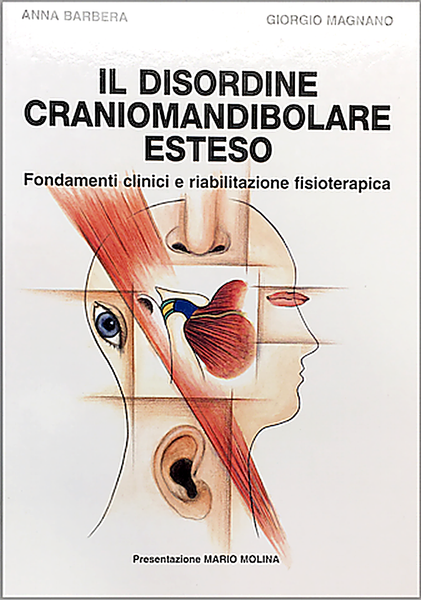
Extended craniomandibular disorders – Clinical foundations of physiotherapy rehabilitation, Brescia 1999
From Mario Molina’s introduction: “Since 1994, Anna Barbera… has worked in the Department of Gnathology at the Italian Stomatological Institute, where she quickly became an indispensable and invaluable point of reference in caring for our patients.
“By combining physiotherapy techniques commonly used for other parts of the body with a deep understanding of the pathophysiology of the stomatognathic system, Anna Barbera can be said to have developed a new discipline relating to physiotherapy for jaw and postural disorders.”
Disorders of the masticatory musculoskeletal system, 1999. Dr. Barbera contributed the chapter: Treatment of cranio-cervico-mandibular disorders.
RE-EDUCATION
Temporomandibular disorders
Re-education for temporomandibular disorders is one of Dr. Anna Barbera’s areas of specialist expertise.
Over the years, she has developed a clinical approach that combines physiotherapy and dentistry, anticipating a perspective that is now increasingly recognised as essential to effectively addressing these issues.
An integrated approach
Temporomandibular joint disorders often require collaboration among different healthcare professionals. Dr. Barbera’s approach is based on integrating physiotherapy and dentistry to provide patients with a more comprehensive course of care.
Experience built over time
For over 35 years, she has treated temporomandibular disorders, developing specialist expertise in an area that is increasingly important in clinical practice.
A focus on the patient and their function
Every treatment plan begins with a thorough assessment of the patient’s condition, with the aim of reducing pain, improving jaw mobility and restoring proper function.
From clinical experience to professional training
Alongside her clinical work, Dr Anna Barbera teaches and helps train healthcare professionals and keep them up to date. This is not a secondary activity, but a natural extension of her clinical practice: what she studies, applies and refines in her day-to-day work becomes a source of training, discussion and shared development.
Teaching is aimed at those who wish to explore specialist topics in a practical, rigorous way that they can apply in their professional work. Particular emphasis is placed on courses that offer ECM credits, providing high-quality, up-to-date training that is genuinely useful.
Book an appointment or request information
Whether you are looking for a specialist physiotherapy program or would like more information about teaching activities, Dr. Anna Barbera’s website is designed to help you find clear answers and a reliable professional resource. In the contact section, you can find locations, contact details and how to request an appointment.
A network of collaborative partnerships for an integrated approach to care
Dr. Anna Barbera’s work involves collaborations with various dental practices and clinics, where physiotherapy is integrated with other areas of expertise to provide patients with a complete, coordinated course of care.
This multidisciplinary approach is particularly important when treating temporomandibular disorders, which require a shared perspective between the physiotherapist and dentist.
VAT No.: 01611240183
info@annabarbera.it
Locations and contact details
Dr. Anna Barbera works at several locations to provide accessible, professional care.
Choose the nearest location and book your appointment.


